
Holy Mothers: Saints Who Heroically Lived the Vocation of Marriage & Motherhood

Amongst the numerous canonized Saints is a group of holy women who also had the honor of bearing the title of "mother." These Saintly women are inspirations to those of us currently striving to live the vocation of marriage and motherhood, and we should rely on them to be powerful intercessors for mothers of all ages and stages.
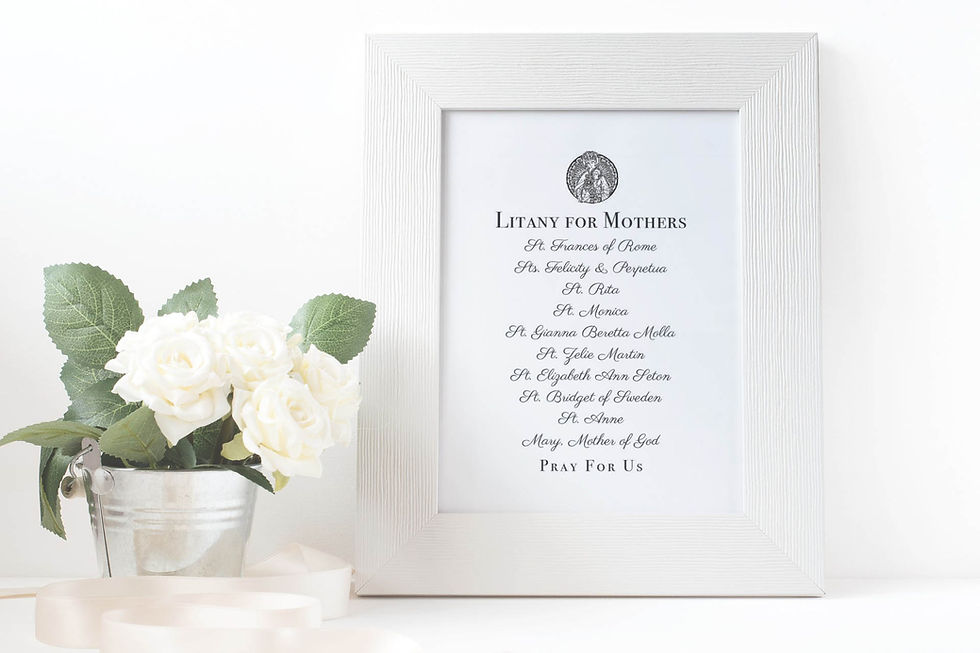
For years, our shop has sold a Litany for Mothers print, but we designed it so long ago that I can't quite remember how we came to decide that these specific Saints should be listed on the litany. Nevertheless, the print bears the names of these eleven holy women, and I like to think these names were inspired by the Holy Spirit. Consider this post an extension of our Litany for Mothers print. It was a delightful journey to take the time to research each of these Saints and their own unique journey as wives and mothers. Read below and get to know the remarkable women who lived out their motherhood vocation and achieved the ultimate goal: sainthood!
Saint Frances of Rome
St. Frances of Rome initially wanted to enter religious life and live a life of prayer and service. However, she was born to a wealthy family who objected to this, and her parents chose a nobleman to be her husband. She soon found that her sister-in-law, Vannozza, also desired to live a life of prayer and service. Together, they ministered to the poor in Rome. St. Frances had three children and was a devoted wife and mother. Later, a great plague would hit Rome and two of her children would die from it. Saint Frances would later open up part of her home as a hospital. She sold all of her possessions and gave generously to the poor and the sick. She founded the Olivetan Oblates of Mary, a society of laywomen who lived in community and served the poor. However, St. Frances did not live in the community until 7 years after she founded it, when her husband had passed away. She spent the remainder of her life living with the society and serving the poor.
Saints Felicity & Perpetua
Sts. Felicity and Perpetua were two mothers in Africa, imprisoned and martyred together for their Christian faith, under the persecution of Emperor Severus. St. Felicity was a 22 year old noblewoman, and in her accounts, she wrote about her great anxiety being imprisoned away from her infant son. Once she received permission to have her son with her, she wrote of the relief she felt and how the “prison became a palace” to her. St. Felicity was a servant who gave birth to her daughter in the prison, just two days before her execution. These Saints were martyred together by a gladiator’s sword in the arena. After their death, St. Perpetua’s son was raised by her family, and St. Felicity’s daughter was adopted by one of the Christian women of Carthage.
Saint Rita
St. Rita, born Margherita Lotti, grew up in Italy and desired greatly to enter religious life. However, her parents were strongly opposed and arranged for her to be married to a cruel and violent man. She was only twelve years old when she became a wife. She had two children: twin sons. Her husband had many enemies and was known for feuding with other families. St. Rita endured great difficulties and abuse in her marriage, but she remained faithful and offered up her sufferings. She was married for 18 years before her husband was murdered by one of his allies, who betrayed him. Her two sons sought revenge, but she prayed they would die before committing the mortal sin of murder. Her prayer was answered, and they died of dysentery a year later. After overcoming a great obstacle to enter, she was finally allowed to join monastery of Saint Mary Magdalene in Cascia. She had a strong devotion to the Passion of Christ, and she received a wound on her forehead, which is associated with the wounds of Christ’s crown of thorns. It caused her great pain and never went away before her death.
Saint Monica
St. Monica lived in Northern Africa, and was married to Patricius, who was a pagan with a violent temper. Her mother-in-law, who shared this temper, lived with them. St. Monica prayed for her husband and mother-in-law for many years, and eventually they both converted before their death. St. Monica had three children, and her younger two children entered religious life when they were older. Her oldest child, St. Augustine, famously lived a wayward life for many years. St. Monica cried many tears over Augustine’s immoral lifestyle. For years, she prayed and offered many sacrifices for his conversion. Eventually, he converted and was baptized at Easter. Shortly after his conversion, she fell ill and died, but before her death, she told Augustine, “Son, nothing in this world now affords me delight. I do not know what there is now left for me to do or why I am still here, all my hopes in this world being now fulfilled.”
Saint Gianna Beretta Molla
St. Gianna is a modern Saint born in Italy in 1922 as the 10th of 13 children. She was a pediatrician, a member of the St. Vincent de Paul Society, and an active participant in a lay movement called Catholic Action. She desired to go on mission and offer medical services to the poor, but her chronic illness kept her from this. She continued to practice medicine in Italy, and at 32 years old, she married her husband, Pietro Molla. By their 4th wedding anniversary, they had three children. St. Gianna prayed the rosary and attended Mass daily. Her husband often traveled on business trips, and they kept in touch through letters. In their letters, St. Gianna wrote about her (relatable) life as a mother, including children who had trouble eating and sleeping, gatherings with extended family, and having her sister Zita come over to help her. Her children had some mild medical issues, with two of them needing to wear an orthopedic brace and one child having a condition that made him prone to vomiting. While her life had its challenges, she wrote with great joy and affection for God and her family.
In 1961, St. Gianna was pregnant with her fourth child. Early in the pregnancy, doctors discovered a large, painful uterine fibroma (tumor) and recommended a complete hysterectomy, which would kill her unborn child. She refused and opted only to surgically remove the tumor and save her baby. While it was a successful surgery, she told her family and doctors throughout her pregnancy, "If you must decide between me and the child, do not hesitate: Choose the child! I insist on it. Save the baby". Her beautiful baby girl, also named Gianna, was born via Cesarean section on April 21, 1962. St. Gianna died from septic peritonitis one week after giving birth, caused by complications during delivery.

Saint Zelie Martin
St. Zelie, born Marie-Azélie Guérin, is a French saint who has the rare distinction of having both her husband and one of her children also be canonized Saints (and another daughter whose cause for canonization is currently open!). She pursued religious life before marriage but was rejected for poor health, since she suffered from headaches and respiratory issues. When she determined her vocation was to marriage and family life, she prayed, “I beg You, then, let me have many children, and may they all be consecrated to You, my God.” She and her husband, St. Louis Martin, were blessed with nine children. Although, four of their children did not survive infancy. Speaking of the great loss of their young children, she said, "We shall find our little ones again up above." St. Zelie struggled to breastfeed and needed to use a wet nurse for most of her children. Her surviving children were all daughters, who grew up to enter religious life. St. Zelie worked as a lacemaker out of her home, and her husband eventually sold his own business to work alongside her. She eventually died of breast cancer when her youngest child, who we know as St. Thérèse, was only 4 years old. St. Zelie and her husband, St. Louis, were the first married Saints to be canonized together.
Saint Elizabeth Ann Seton
St. Elizabeth Ann Seton was born into New York high society in 1774 and was raised in the Episcopalian faith. Her mother died when she was just 3 years old, and she was just 19 years old when she married a wealthy business man, William Magee Seton. The couple had five children together. When St. Elizabeth was just 30 years old, her husband’s business had failed, and he died suddenly of tuberculosis. As his health declined, the family had gone to Italy in hopes he would recover there. It was in Italy that Elizabeth grew to know and understand the Catholic faith. She returned to the United States and converted to the Catholicism, but her family and friends rejected her because of her new faith.
Soon after, she was recruited to help start a new religious order that would run a small school for the religious education of children. Elizabeth was the first recruit to take her vows, and the archbishop gave her the title “Mother Seton.” The new order, Sisters of Charity of St. Joseph, was formed and opened the first free Catholic school for girls in the United States, St. Joseph Free School. St. Elizabeth would lead her community to establish another school and two orphanages during her life. She is credited with laying the foundation for the parochial school system in the United States.
Her children always remained under her care, even while establishing the religious order. She suffered great loss during her life, and two of her daughters, two sisters-in-law, and eighteen religious sisters died during her time as Mother Seton. Her two sons joined the Navy, and her remaining daughter, Catherine, joined the Sisters of Mercy. Her son, William, married and had 9 children, one of which became Archbishop Robert Seton of New York. Mother Seton died of tuberculosis at the age of 46, just 16 years after she converted to Catholicism.
Saint Bridget of Sweden
St. Bridget, also known as Birgitta, was born into a noble and devout family. It should be noted that St. Bridget was a mystic and began receiving visions in her youth. Her mother died when she was just ten years old, and at 13, she married her husband, Ulf Gudmarsson. The couple had 8 children, who all survived infancy, and one of their daughters even became a canonized Saint, St. Catherine of Sweden.
Her husband fell terribly ill on their return from their pilgrimage to Santiago di Compostela. Deeply concerned for his life, St. Bridget prayed by his bedside all night and received a vision from a bishop who told her her husband would recover and that “God had great things for her to do.“ Ulf recovered, but not long after their return, he fell ill again and died. They had a loving marriage, and when he died, she said that she “loved him like my own body.” After his death, she would follow God’s call for her and start a religious order, Bridgettines, also known as the Order of the Most Holy Savior. With land donated by King Magnus Eriksson, the construction of a new monastery began. However, St. Bridget would never get to see the completion of the monastery. She received a vision of Christ asking her to go to Rome and stay until the Pope returned from France. She immediately went to Rome and continued to receive many visions regarding Popes, kings, and the reform of the Church. Shortly after, her daughter, St. Catherine of Sweden joined her, and they spent the next 25 years in prayer and meditation, caring for the poor, and leading pilgrimages from Rome to the Holy Land. She died in Rome, shortly after returning from one of their pilgrimages to the Holy Land, which one of her sons was able to join. She is know as the the “Patroness of Failures,” as she never returned to Sweden, saw the convent completed, or witnessed the Pope’s return permanently to Rome. However, her daughter brought her remains back to Sweden, buried them at the convent, and became the Superior of the order.
Saint Anne
St. Anne is the mother of the Blessed Virgin Mary, making her the grandmother of Jesus Christ. For these reasons alone, she is an excellent intercessor for mothers! It is said that she and her husband, St. Joachim, could not conceive a child for many years, and when they did finally conceive of the Blessed Virgin Mary, they were purely chaste and had no lust in their heart. St. Anne bears the titles Mother of the Poor, Patroness of the Childless, Help of the Pregnant, Model of Married Women and Mothers, and Protectress of Widows. Many young women ask St. Anne’s intercession to find them a holy husband, and the devotion has been summed up in the common saying “St. Anne, St. Anne, bring me a man as fast as you can!”
Mary, the Mother of God
This list would not be complete without Mary, the Mother of God. While our Blessed Mother holds many titles, her highest title is that of Mother of God, and it is of such importance that its feast day is a Solemnity and holy day of obligation in the Catholic Church. She is first recognized with this title by her cousin Elizabeth who exclaimed, "And how does this happen to me, that the mother of my Lord should come to me?” When Jesus was on the cross, he gave us Mary as our own spiritual mother (through the person of John the Evangelist) when he said “Behold your mother.” As our spiritual mother, we can call upon Our Lady’s intercession in truly everything. St. Teresa of Calcutta gave a great example of this and often prayed , “Mary, Mother of Jesus, please be a mother to me now.” She said this prayer has never failed her.
Comments